I’ve spent a lot of time thinking about why so many of us feel disconnected from politics.
It’s easy to blame the politicians. And sure, they deserve a fair share of it. But the real problem goes deeper. Our democratic system has become incredibly good at hearing the people who already know how to be heard.
The loud. The organised. The well-connected. The well-funded.
When a government “consults” the community, they mostly hear from the people with enough free time to attend a meeting, or the professional activists who know exactly which buttons to press.
That’s fine, as far as it goes. But those people aren’t Australia. They are just the people with the loudest microphones.
That’s why I was interested to see the Community Strong Australia Constitution that I was sent today from here
As a starting point, it’s solid. It recognises that community engagement is a core value. It sets up “Local Teams” and a “Community Engagement Committee.” It tries to build a party from the ground up instead of the top down. That is a massive step in the right direction.
But as I read through it, I found myself asking one question:
How does this actually hear the silent majority?
The Problem with “Showing Up”
The Constitution says Local Teams should “amplify community voices.” It creates the structure. It builds the room. But it doesn’t give us the methodology. It doesn’t tell us how we make sure we aren’t just hearing the same noisy people.
In every volunteer group, you face the same trap: the people who turn up are the people who have the time, the money, and the flexible jobs to be there.
The single parent working two jobs isn’t at the meeting. The shift worker isn’t writing a twenty-page submission. The young renter trying to survive the housing crisis isn’t sitting on a committee.
These people are the “silent majority.” They aren’t silent because they don’t care. They are silent because our current ways of “listening” actually exclude them.
If we only listen to the people who show up, we aren’t hearing the community. We are just hearing the “highly engaged.” And let’s be honest—they often have a very different set of priorities than the rest of us.
Democracy Needs a Hearing Aid
This is where my idea for the “Teal Senate” and the use of Citizens’ Juries comes in.
Instead of asking, “Who wants to come to a meeting?” we should be asking, “Who have we randomly invited?”
A Citizens’ Jury works like a legal jury. You pick people at random—like a civic lottery. You make sure the group looks like Australia: different ages, different jobs, different suburbs. You pay them for their time so it’s not just a hobby for the wealthy.
Then, you give them the facts. You let them hear the experts. You let them talk to each other. And then they tell us what they think.
They aren’t “loud.” They aren’t “noisy.” They are just us.
Turning Down the Megaphones
One of the principles I’ve written about is “Democratic Equalisation.”
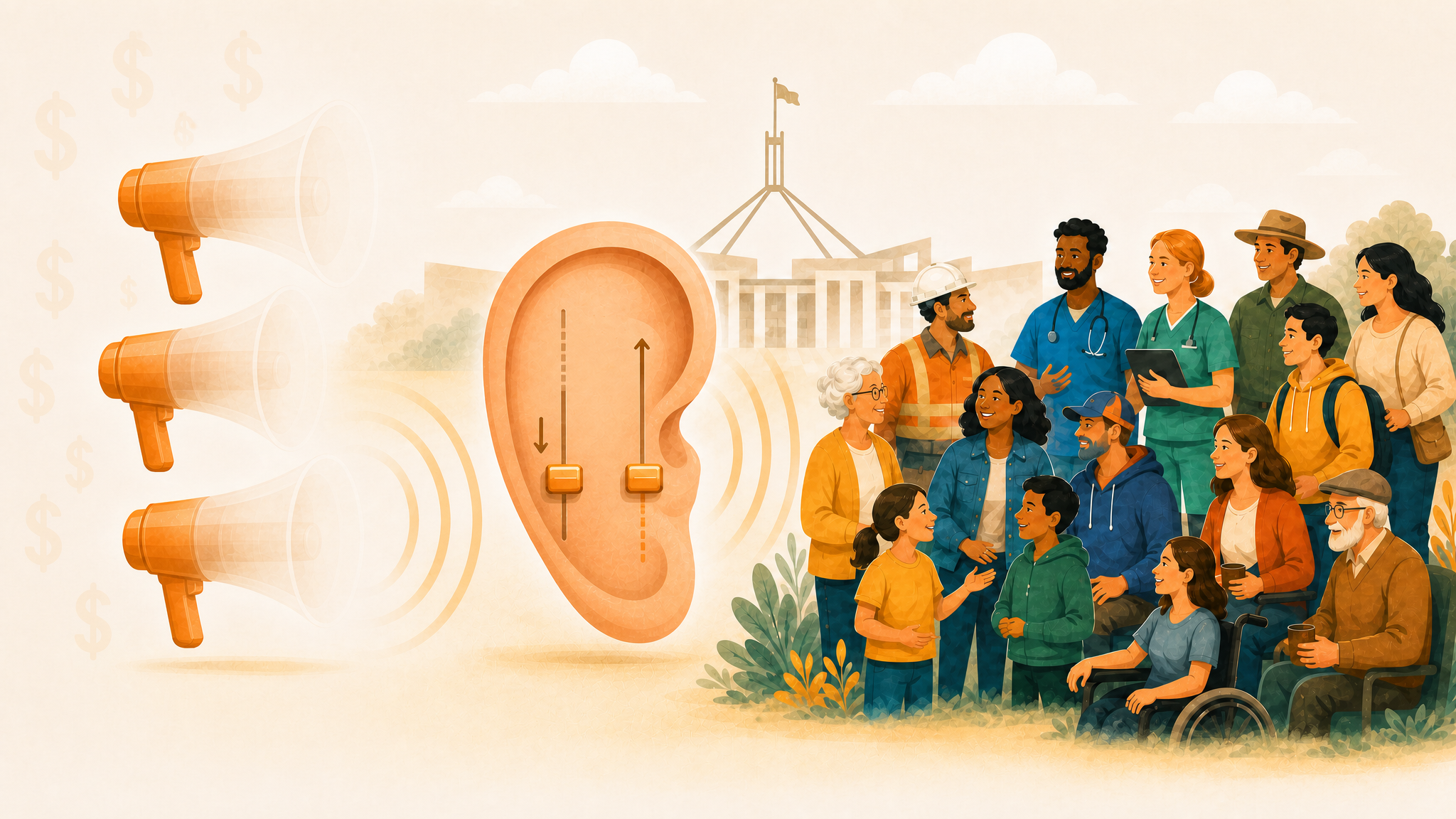
Think of it like an audio mixer. Currently, the “Money” and “Loudness” channels are pushed all the way up to 10. The “Ordinary Citizen” channel is sitting at 1.
The goal isn’t to mute the loud voices. It’s to normalize them. We need to turn the megaphones down to a 4, and turn the volume of the quiet majority up to a 4.
The Community Strong Constitution builds the soundboard, but it doesn’t yet have the sliders set correctly. It doesn’t address how to stop privileged people from dominating the conversation.
The Next Step
I like that this Constitution leaves room to grow. It doesn’t lock everything in stone.
My advice to the movement is simple: don’t just build a new way to “consult.” Build a new way to listen.
Whenever we have a big decision to make, we shouldn’t just look to our most active members. We should convene a representative Citizens’ Jury. We should reach past the people at the microphones and find the people in the quiet streets who think politics has forgotten them.
Democracy doesn’t have a speaking problem—everyone is shouting. It has a hearing problem.
If we want to fix Australia, we need to stop rewarding whoever shouts the loudest and start listening to the people who have been squeezed out of the conversation.
That’s how we make community truly strong.


Latest posts by Craig Lambie (see all)
- Community Strong Starts in the Right Place. But Democracy Needs Better Ears - June 25, 2026
- NeoDb – display shelf on WordPress - April 16, 2026
- Great PDF converter tool - April 10, 2026
